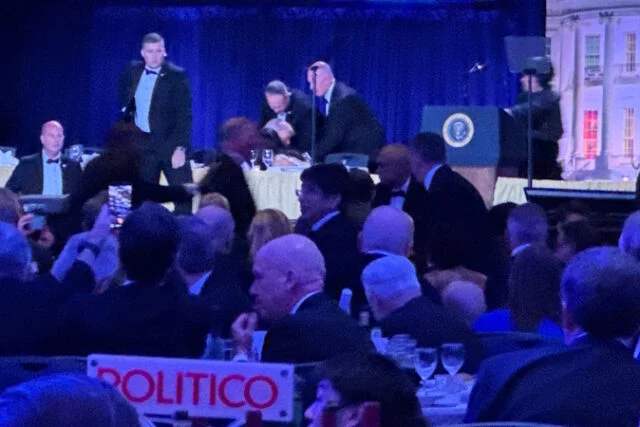
The date April 25, 2026, will be etched into American history not for the glitz of the White House Correspondents’ Association (WHCA) dinner, but for the chilling echoes of gunfire that reverberated through the halls of the Washington Hilton. For the third time in less than two years, President Donald Trump has been the target of a violent assassination attempt. While the swift intervention of the United States Secret Service (USSS) prevented a national tragedy, the incident exposes a recurring and dangerous pattern in the architecture of modern protective operations.
To understand the gravity of this latest breach, one must look beyond the immediate tactical response and interrogate the systemic failure of preventative security philosophy. This article examines the security lapses that allowed an armed assailant to infiltrate a high-profile presidential event and offers a constructive critique of the outdated “hard shell, soft center” approach that continues to put national leaders at risk.
I. The Anatomy of a Breach: What Happened at the Washington Hilton?
The White House Correspondents’ Dinner is one of the most complex security environments in Washington. It combines the prestige of the presidency with the chaos of a Hollywood red carpet, involving thousands of guests, celebrities, and journalists. On the night of April 25, the assailant, identified as Cole Tomas Allen, was able to enter the hotel while carrying multiple weapons, including a shotgun, a handgun, and several knives.
According to preliminary investigative reports, Allen had checked into the hotel as a guest days prior. This detail is the first and perhaps most significant failure of prevention. In a post-2024 landscape—marked by the traumatic rally shooting in Butler, Pennsylvania—the assumption that a hotel guest list is a “vetted” population is an archaic and lethal oversight.
The suspect was only confronted when he attempted to storm the ballroom checkpoint where the President was scheduled to speak. While the Secret Service successfully neutralized the threat at that “inner ring,” the fact that an individual with high-capacity weaponry was able to navigate the hotel’s lobby and corridors during a presidential visit represents a catastrophic failure of the outer perimeter.
II. The “Soft Perimeter” Fallacy: A Constructive Critique
The primary failure at the Washington Hilton was the reliance on a fragmented security zone. In high-threat environments, security is traditionally conceptualized in concentric circles. However, in the context of a public-facing hotel event, the Secret Service often faces a “convenience vs. security” trade-off that prioritizes guest flow over total lockdown.
1. The Gap Between Exterior and Interior Screening
At the Washington Hilton, magnetometers and physical searches were localized at the entrance to the ballroom. This created a “hardened interior” surrounded by a “soft” public space. This strategy assumes that the danger is only localized to the principal’s immediate physical vicinity.
Constructive Reform: Security for presidential events in public venues must shift toward a Total Building Perimeter (TBP) model. If a sitting President is inside a structure, the entire structure must be considered a “sterile zone.” The technology exists to implement rapid, non-invasive screening at building entrances (such as AI-driven millimeter-wave scanners) that do not hinder the flow of hotel guests but would have immediately flagged the metallic signatures of Allen’s arsenal.
2. The Failure of Pre-Event Intelligence and “Stayers”
The suspect was a guest at the hotel. In the days leading up to the event, his movements and the transportation of his gear went unnoticed. Modern protective intelligence should involve a more robust partnership with hotel management.
Constructive Reform: For “Tier 1” protectees, the Secret Service must implement a Temporary Credentialing System for all hotel guests and staff present during the protection window. This includes mandatory background sweeps of guest lists 72 hours prior and the use of covert surveillance (plainclothes agents) in common areas like lobbies and elevators. The assailant was able to hide in plain sight because the security plan treated the hotel as a neutral space rather than a high-risk zone.
III. Learning from History: Why Butler and West Palm Beach Weren’t Enough
To provide a fair critique, we must acknowledge that the Secret Service has been operating under unprecedented stress. The 2024 attempts—the rooftop sniper in Butler and the perimeter breach at the West Palm Beach golf course—resulted in leadership changes and promises of reform. Yet, the 2026 Hilton incident suggests that the agency is still fighting the last war rather than anticipating the next one.
In Butler, the failure was line-of-sight management. In Washington, the failure was environmental saturation.
The common thread is a lack of adaptive planning. The Secret Service remains excellent at reacting to a drawn weapon (the “moment of impact”), but it remains dangerously reactive in the “pre-attack phase.” True prevention requires a shift from “protection” to “proactive disruption.”
IV. The Human Cost of Complacency
While the President remained unharmed, a Secret Service agent was shot and injured during the exchange. This highlights a moral imperative: security failures do not just endanger the principal; they place an unfair burden of heroism on the individual agents who must make up for poor planning with their own lives.
Constructive criticism is not an attack on the bravery of the agents on the floor—it is an indictment of the logistical framework provided by agency leadership. Bravery is not a substitute for a secure perimeter.
V. Moving Forward: A Three-Point Path to Prevention
To prevent a fourth attempt, the United States must overhaul the protocol for presidential appearances in non-government buildings:
- Mandatory Exterior Magnetometry: No person should enter a building housing the President without passing through a primary screening point at the street level. The “hotel guest” exemption must be abolished.
- Integrated Tactical Tech: The use of autonomous floor-roving drones and AI-integrated CCTV could have identified a man moving toward a ballroom with a long-gun bag. Security in 2026 cannot rely solely on human eyes.
- The “Buffer Zone” Requirement: High-profile indoor events should require the “buffer floors” (rooms immediately above, below, and adjacent to the event space) to be cleared and swept, or occupied by security personnel.
Conclusion
The April 2026 attempt on Donald Trump’s life was a “near-miss” that the nation cannot afford to ignore. We have moved into an era where political volatility is the baseline, not the exception. The Washington Hilton incident proves that “standard operating procedure” is no longer enough.
Prevention is about removing the opportunity, not just stopping the bullet. Until the Secret Service adopts a philosophy that prioritizes environmental dominance over localized protection, our national leaders will remain targets in their own backyard. The transition from a “reactive” agency to a “preventative” one is the only way to ensure that the next headline isn’t a tragedy.