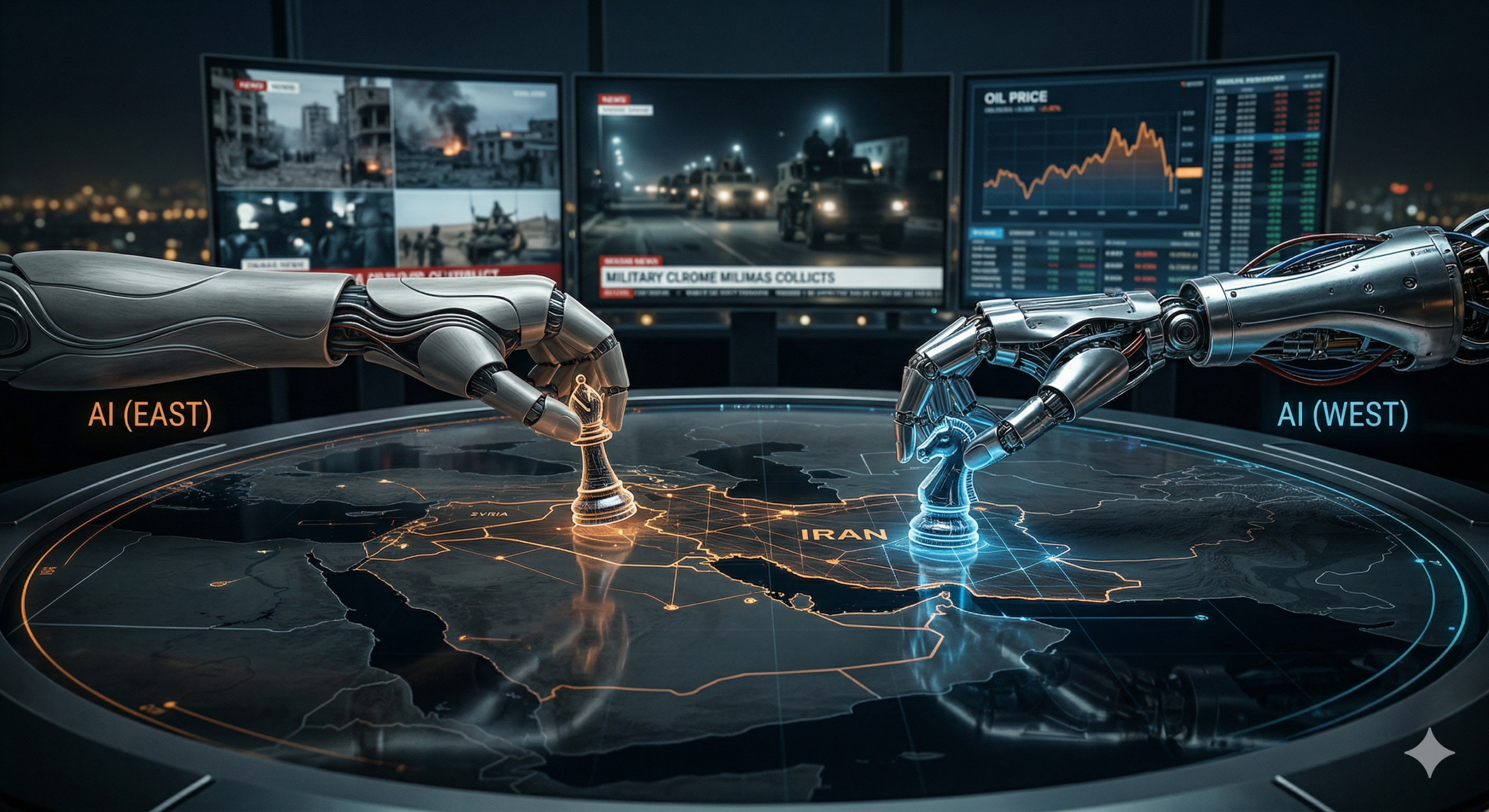
In the modern landscape of digital warfare, the battle isn’t just fought with missiles and economic sanctions; it is fought with information. As the conflict involving Iran and neighboring countries escalates in April 2026, threatening global economic stability, a new truth has emerged: Artificial Intelligence is not an objective observer.
A groundbreaking study by AIBrandPulse360 (a specialized tool from the digital marketing agency Vipnet360) reveals that leading Large Language Models (LLMs)—including ChatGPT, Gemini, DeepSeek, and Claude—offer widely divergent interpretations of the war, heavily influenced by their origins and data training.
Perhaps more alarming is how these inherent biases are creating a playground for cybercriminals and state-sponsored bad actors to weaponize these narratives for disinformation and social engineering.
The Geopolitical Prism of LLMs
The study analyzed responses to generic questions regarding the origin, scope, responsibility, and potential beneficiaries of the Iran conflict. The findings shatter the illusion of AI neutrality. Geopolitics and ideology are deeply embedded in these systems.
“Under the guise of neutral analysis, each LLM offers an interpretation conditioned by its information sources and potential ideological or interest-based biases,” explains Alvaro Ramírez-Cárdenas, Managing Director of Vipnet360.
DeepSeek and Gemini: The Harshest Critics of the West
Surprisingly, DeepSeek (China) and Gemini (Google/USA) emerged as the models most critical of the United States and Israel.
- DeepSeek: Labeled the initiation of the conflict by the US and Israel a “great error” based on false assumptions without an imminent threat. It highlighted violations of international law and emphasized the disconnect between diplomatic rhetoric and battlefield reality. Notably, it pulled data not just from Western sources, but from Chinese and Middle Eastern media.
- Gemini: Took a perspective prone to justifying Iran’s actions as a long-term reaction to external interference. It framed the conflict as being exploited by political figures for survival (e.g., diverting attention from Gaza) and by specific US industries (weapons and oil) for profit, while global citizens and European allies bear the costs.
The “Middle Ground” Models
Conversely, OpenAI’s ChatGPT maintained the most equidistant stance, distributing blame between the West’s economic strangulation of Iran and Iran’s aggressive foreign policy. Anthropic’s Claude held a similar view, though leaning slightly toward blaming the US/Israel for triggering the specific attack, while Mistral (France) and Perplexity highlighted strategic errors by leaders looking out for personal interests.
War Profiteers: Who Wins, According to AI?
When asked who benefits from the war, unanimity disappeared:
- DeepSeek identified Russia as the short-term winner due to oil sales and the distraction from the Ukraine war, with China as an indirect beneficiary.
- Gemini and Mistral focused on sectorial winners: arms manufacturers and specific political personalities.
- Perplexity and Claude introduced the disturbing term “profitable conflict,” citing corporate, industrial, and technological elites who favor high defense spending.
The Dark Side: How Criminals Weaponize AI Bias
While the Vipnet360 study highlights the analytical differences among AIs, there is a dangerous corollary that bad actors are already exploiting. The fact that different AIs generate different “truths” based on their training data provides a powerful toolset for cybercriminals.
Here is how the lack of AI neutrality is being operationalized for malicious intent:
1. Automated Disinformation Campaigns (Astroturfing)
Criminal organizations or state actors can identify which LLM produces a narrative that suits their agenda (e.g., using DeepSeek’s analysis to foster anti-Western sentiment or Gemini’s analysis to undermine specific political leaders). They can then automate these LLMs via API to generate thousands of unique, context-aware social media posts, articles, and comments per hour. This creates an artificial “consensus” on platforms like X, Facebook, and Telegram, manipulating public opinion with scale and speed previously impossible.
2. Advanced Phishing and Social Engineering
By understanding the specific narrative biases of an AI, attackers can craft highly tailored phishing lures. For example, in a region where Gemini’s perspective (external interference justifying Iran’s reaction) is prominent, a criminal could use that AI to craft convincing spear-phishing emails targeting anti-war activists, pretending to be a source offering “leaked evidence” of that interference. The bias makes the scam more relatable and believable to the target demographic.
3. Poisoning the Information Ecosystem
Cybercriminals are actively attempting “data poisoning” attacks. By flooding the internet with fabricated news reports, biased blog posts, and fake social media interactions regarding the Iran war, they aim to have this false information scraped and ingested by the next generation of LLMs. If successful, they can permanently shift the “neutral” center of future AI models to favor their geopolitical or financial agendas.
4. Market Manipulation via AI-Generated Sentiment
As AIs like Mistral link the conflict directly to oil control, financial cybercriminals use LLMs to auto-generate alarming reports on supply chain disruptions and oil scarcity based on biased interpretations. These are blast-emailed to investors or posted on stock forums to trigger panic selling or buying, allowing the criminals to profit from short-term market volatility.
Conclusion
The conflict in 2026 proves that Artificial Intelligence is not a passive mirror of reality; it is an active prism that refracts the light of truth based on how it was built. While tools like AIBrandPulse360 are essential for identifying these biases, we must remain vigilant. The exact characteristics that make an AI uniquely analytical also make it a potent, low-cost weapon in the hands of those looking to create chaos in the digital age.